
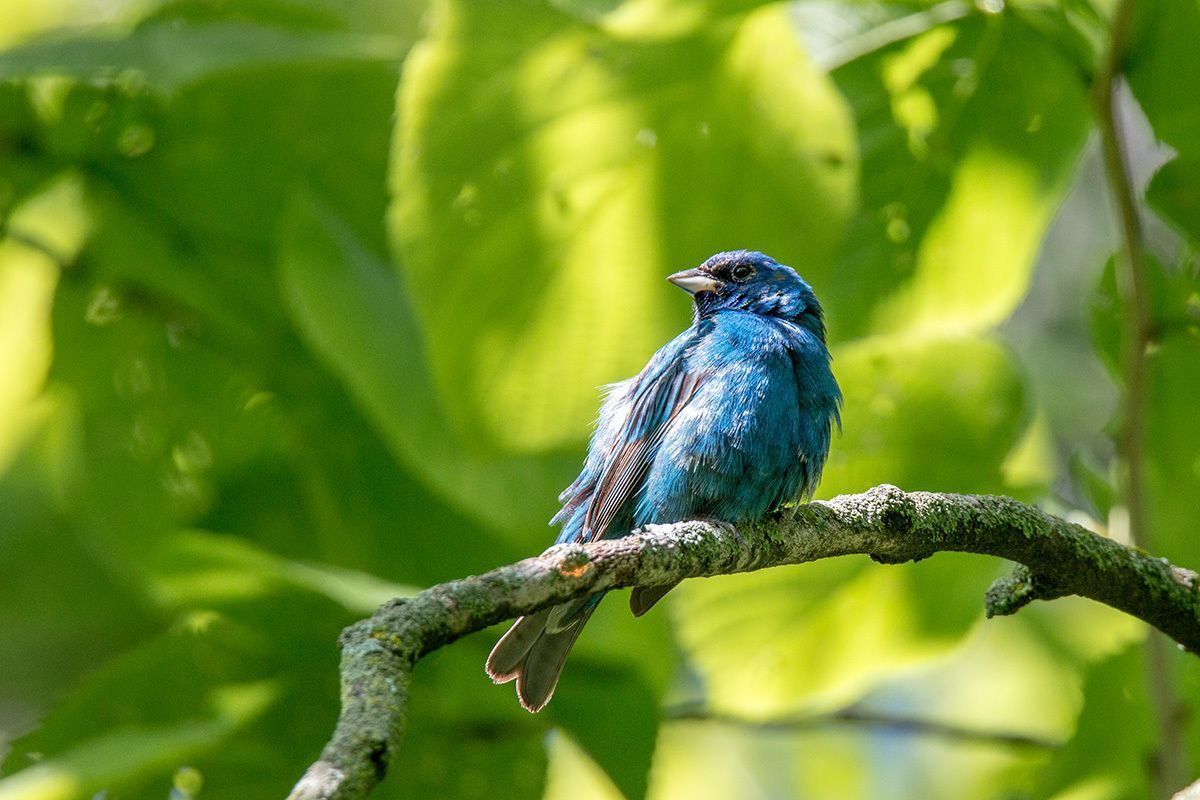
Photo: Indigo Bunting by Mike Benkis
If you learn one new song this spring, let it be the Indigo Bunting’s. At first it might sound like a jumble of cheery notes. But listen again and you’ll notice a pattern. Each phrase is repeated, so that each song is made up of a few doubled phrases. I might transcribe one song in phonetics like this: see it, see it; here, here; cheery, cheery. Listen to examples on All About Birds. Once you know how to pick out those doubled phrases from the background of the spring bird chorus, you’ll never miss it.
While knowing the song is enough of a treat, it also makes it easier to track down the singer for a better view. If I hear an Indigo Bunting, my instinct is to look high up in trees on a wooded edge. Sometimes it takes a minute, but finding the bunting means being rewarded with one of the most vibrant blue plumages in the bird world. Then, keep an eye out for the brownish female to see if you’ve happened upon a breeding pair here to stay the summer.
Once you’ve got the song down, you might find yourself impressing even a seasoned birder: first you catch some faint doubled phrases from 100 yards away, then you spot two little dots on a power line with the naked eye, one blue and one brown. “Indigo Buntings, breeding pair,” you say, nonchalantly, and the veteran birder next to you hastens to get a fix on them, too.
Once you’ve learned one new song, much like grabbing another Pringle from the can, it’ll be hard to stop yourself from another. The Eastern Warbling Vireo is a tiny bird whose song is like a nasally, sped-up version of the familiar American Robin song. So if you know the American Robin, listen for a hoarser, faster version of it that ends on an up note. And look for the singer. Eastern Warbling Vireos have grayish backs and faint yellow bellies. Their movements stand out more than their feathers: they’re usually moving quickly among new leaves eating insect larvae.
Well, we’ve learned two new songs, so let’s add on a third. The Nashville Warbler brings a delightful pop of yellow in the spring, and you can find it even in dense neighborhoods. Males have bright yellow breasts and bellies, with gray heads, greenish backs, and a white eyering. Females and immature males have a paler version of those colors. The song usually has a two-part pattern. Cornell Lab of Ornithology spells it out this way: “see-bit see-bit see-bit see-bit see-bit titititititi." The first part is slower, and the second part is faster. Listen to some samples and see how fast the song becomes familiar.
As you learn songs, you’ll find that what was once an indistinct but pleasant blend of bird voices now becomes an ensemble where you can identify individual singers.


